Tiers before lunchtime
The date was the 10th August 1993 and I was hopelessly lost, woefully hungover, and seriously late. For an appointment with one of the most formidable intellects on the wine planet, Brian Croser. An individual known not to suffer fools, and I was definitely feeling like a complete and utter one when I finally managed to find a public phone atop what I now know to be Mount Bonython, and called the winery for directions.
When I—eventually—trudged apologetically into the Tapanappa (nee. Petaluma) lab, Croser was deadpan except to say, ‘That’s the worst hangover I’ve seen enter this room.’ Or something to that effect. He then graciously asked if I first wanted to taste the line-up of wines he’d prepared for me, or head immediately for a pie and pint for lunch. This being how just how tardy I was for our mid-morning appointment. So, I fathomed through the fog: a sound heart, in addition to a great mind. Despite my condition, I elected to taste.

Tiers 1.5m Chardonnay: either 76 or 95 (Bernard clones). Pic: Tim White
They were all glasses of chardonnay on the bench: five vintages—1987 to ’91—of finished (meaning bottled) Petaluma Chardonnay; and then five samples unfinished (drawn from barrel). These were of the 1992 harvest although other detail was undisclosed, except that they were all Petaluma dedicated vineyards of origin.
So, taking a deep-breath or two I plunged in, hoping that any observations I might make—if solicited—would redeem me somewhat. (Even now, many thousands of tasting samples—and a few more hangovers—later, this is the sensory stuff I relish. To be challenged, and then have to attempt to figure out why the liquid in the glass smells, tastes and stimulates in the way it does.)
Piccadilly Deep Diving
It soon became apparent that the barrel samples were intended to be the primary focus of this exercise. Croser did indeed request that I proffer unvarnished observations of the wines in front of me.
There were two standouts to my palate: wines two and four. The others were all extremely good, but did not possess the intensity and character of the other two. Wine five was a touch too lychee herbaceous and the acidity was a bit up there.
Wine two had a lavender-like aromatic character while the deep, citrusy pear fruit was already woven beautifully with fabulous oak mouth-aromas. (These observations I’m referencing from the notes inputted on the day into my FileMaker tasting note database installed on a much-loved Apple Powerbook 165c).
Wine four was different but enthralling for other reasons. It didn’t possess quite the same complexity on the nose as two, but—weirdly perhaps as I didn’t have a clue where the fruit came from so no palate memory entry of reference—it smelled like it would become so in time. In my vernacular I describe this as ‘incipient’ or ‘latent’ complexity. It was, however, incredibly intense in the mouth—powerful across the palate—with mouth-aromas lingering long. So an affirmation of my observation about the latent complexity evident in the nose. Or so I deduced as the mist had begun to clear.
From memory Croser just nodded and exchanged words of agreement and—certainly—otherwise. Then came ‘the reveal’. Which, if you’re not acquainted with wine tasting lingo, is the moment you know whether you’ve performed your tasting duties admirably, or really fucked it up. There’s rarely anything in between.

Mid-row beneath the nets of The Tiers 1.5m block. Pic: Tim White
And so. Wine 1 - a blend of Bruce (just a little to the north and east of Tiers) and Shed (Summertown) vineyards. Wine two - Shed plus Aldo’s and Pat and Ted’s, but mostly the Mount Bonython components from Croser’s mum and dad’s vineyard and that of Aldo Bratovic. Wine 3 - Pfitzner (my notes don’t indicate where this is exactly). Wine 5 - Shed.
But back to wine 4—Tiers—the vineyard I’d finally found my way too. As everyone who cares deeply about the history of chardonnay in Australia knows Tiers is held in exceptionally high regard. Up there with the revered likes of Giaconda in Beechworth (Victoria), Tyrrell’s Short Flat in the Hunter (New South Wales), and Leeuwin Estate's ‘golden acre’ in Margaret River (Western Australia). All hallowed ground for this grand cultivar. You’ll find plenty of fascinating Tiers vinicultural detail here. This was my first experience tasting Tiers in its purest, most uninhibited liquid form. The first single-vineyard Tiers would be bottled a few years later from the 1996 vintage.
So perhaps a little redemption for my tardy arrival? We departed to the Aldgate Pump for a steak and kidney pie and—for my part—a pint or two of Kent Town Ale.

Take your pick — 95 or 76?. Pic: Tim White
Back to the Future
So why—thirty five vintages later—do I now relate this? Well for one, it’s a positive thing at any time to get stories out about such exciting discoveries out there—even ones of such distance. These experiences matter on wine. Especially when they pertain to the most important thing that creates such special wine experiences: the unique places that grow the grapes—which themselves may exhibit particularly distinctive, personal clonal poperties—and the individuals that have elected to cultivate and care for them. Places which will (hopefully) continue to provide pleasure into the future.
Tiers, and the other special vineyards mentioned above—and others elsewhere that have found their right place to be and matured in the meantime—are important because these are unique plots of land which grow wines imbued with a spirit of place.
But also now because I’d like to single out Pat and Ted’s vineyard from the list above as it provides the bedrock for Tapanappa’s PV Chardonnay. Which, as you might notice from my 2024 Tapanappa review trifecta, is my frontrunner (at least at this stage of its life) in this vintage. Age-wise, it—and Aldo’s, Eric’s, Bruce’s and Summertown Shed—are all honourable contemporaries. Indeed Pat and Ted’s is older—and therefore more mature—than the Tiers 1.5m.
Like Tiers, these founding vineyards in the nascent winegrowing region of the Adelaide Hills, were all planted between 1978 and 1983, and would later be classified within the Piccadilly Valley sub-region (a so-called, Protected Geographical Indication, or G.I.) which was formalised in 2000. They were all established with similar clonal material also. Or at least they were assumed to be, which is yet another fascinating—and complex—local vinicultural tale.
Twenty-twenty four is not the first vintage where I’ve had the PV in—or near—the top tier either. In 2021 it was the equal to the 1.5m although the Tiers was in a class of its own that vintage. In 2018 it was only just pipped by the other two. In ’18 the trio were among the finest chardonnays from anywhere in the land.
Of those 2018s that I was fortunate to encounter in my half-blind line-ups, that is. These included Giaconda, Leeuwin Art Series, Hoddles Creek Syberia and 1er, Oakridge 864 Aqueduct Vineyard - Henk, Tolpuddle, Moorooduc McIntyre; Flametree S.R.S. So the PV was in magnificent company.
While researching this piece it was also interesting to discover—for me at least—that at another tasting of chardonnay barrel samples included in a larger tasting Brian presided over in 1996 (to which I punctually arrived) I had the Mount Bonython selection second only—again—to a Tiers/Bruce combo. Sexy was one of the words I used on the day to describe it too.
The two other vineyards which make up the balance of the ‘24 PV are Bussell’s (nee. Bruce’s, cited above), which sits immediately to the west of Tiers, and Wilson’s which, if my notes are accurately recorded from the ‘96 barrel tasting, is what was then referred to as St. Margarets. It is located in the Basket Range to the north. So these are both Piccadilly Valley vineyards of eminent pedigree.
So too is Aldo’s. And here’s another serendipitous reason to be publishing these words now. It was on the Sunday of the long-weekend just passed—8th March, 2026—that I was delving into my tasting note database to reference my impressions of the barrel samples noted above.
Now, Aldo (Bratovic) and I reacquaint ourselves every once in a while, but we’d not communicated for a year or so, until he dropped by Frewvilleland to say hello on Tuesday 10th. (I do four shifts a week on the deli and occasionally assist on the cheese bar should you desire or require any counsel on other delicious fermented things derived from meat and milk).
I was somewhat preoccupied—and also close to clocking off—but called him shortly thereafter. 'Let’s catch up was the gist', but among other things I learned that the beautiful grapes grown on his Mount Bonython vineyard were no longer headed for anonymity at Pernod-Ricard—albeit into some pretty classy Orlando chardonnay—but were returning to their original fold.
With the 2026 harvest—and this is affirmed in per comms. by Lucy Croser—Aldo’s Mount Bonython-grown grapes will reunite with those of her grandparents Pat and Ted’s vineyard. ‘The chardonnay cosmos has spoken to me,’ I quipped to Aldo. Who, as an individual committed to science, immediately replied: ‘Don’t get all spiritual on me, Tim.’ But I will nevertheless reiterate: spirit of place. In it is everything meaningful.

Too early for Tiers chardonnay: a tractor returning to the Bizot vineyard for more whole-bunches of pinot destinned for Daosa Natural Réserve. Pic: Tim White
Directions for the senses
For those who may now be enthused to make a trip to this special place for chardonnay, or one who has already made a pilgrimage near to the mount of Bonython, you might be wondering how on earth I could have get so mislaid that day, hungover or not.
Well, this was before the Heysen Tunnels connected to the South-Eastern Freeway, when one had to negotiate the winding climb up Mount Barker Road past the Eagle on the Hill unaided. Pre-mobile, let alone smart phones. So no Google, nor Apple mapping to guide the way. This is an excuse of sorts I put to the (hopefully) younger people reading these words. As to why my directional bamboozlement was not only down to a day on the booze.
Tiers is a place I’ve visited many times now and it never ceases to make the heart beat a little faster with expectation of what may be at the end of the journey. An impomptu tasting directly from barrel with the man himself of the 2023 Tapanappa chardonnays in July of that year is another I recall (so considerate, thank you). As well as then also having a peek at the single-vineyard Foggy Hill pinot noir clonal and block components afterwards.
The only other vineyards which’s thresholds I’ve passed more would be those of Panayiotis ‘Bunny’ and Yvonne Peglidis, and the hallowed ground of A.P. Birks Wendouree: both in Clare. Actually, thinking about it, I’ve also spent good bit of time at De Bortoli’s singular Dixon’s Creek property in the Yarra over the years.
The pictures illustrating this story were taken on the 5th March 2021. I’d asked for permission beforehand to do so, of course, and Brian instructed me to give him a call when I arrived. Which I duly did, only for him to relay that he was at the Uraidla Bakery getting breakfast croissants for the vintage crew. He thoughtfully asked if I wanted one, but I declined saying that I’d only just finished a double Sausage and Egg McMuffin®. To which he replied, ‘Tim, you’ve gone down in my estimation.’ A comment with which I was quite pleased, because I didn’t realise that I was particularly up there anyway.
So, to be clear about the directions. After exiting McDonald’s Frewville—or Adelaide’s Finest Frewville if a ham and cheese croissant is more your thing—head up Glen Osmond Road to the South-Eastern Freeway (a.k.a. Princes Highway) and ascend; take the Crafers exit, which is the first one after passing through the Heysen Tunnels; go straight over the roundabout, through Crafers village, and turn into Piccadilly Road; then lower the windows and follow your nose—or smart phone—to the turn-off for Spring Gully Road.
Another few hundred metres along the north side of the road and you should arrive at the gateway to ‘The Tiers’. So: fifteen minutes from Macca’s to Tapanappa, and one of the great chardonnay vineyards of the world. Get lost in the wine.
Tapanappa Wines, 15 Spring Gully Road, Piccadilly SA 5151

Tapanappa's ‘24s
Tapanappa PV Chardonnay 2024 (Piccadilly Valley, SA)
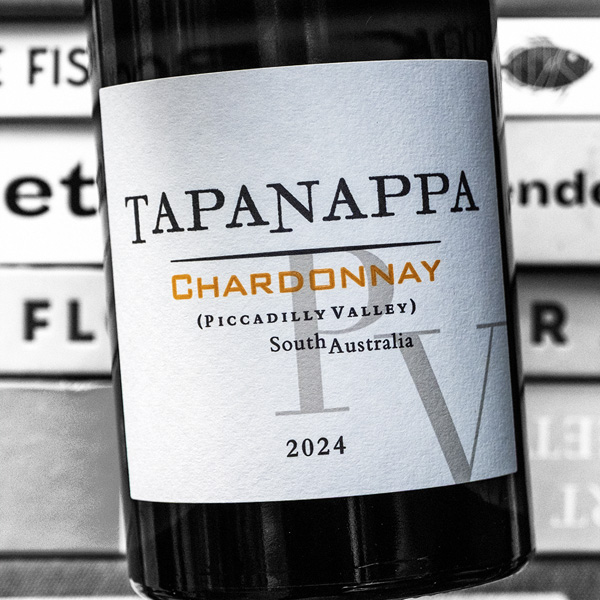
Has a dehydrated peach-pear glow. Some just-ripe apricot and a sniff of the sublimest vanilla slice you can imagine. Subtle baking spice with air and the fruit getting a little more poached and wobbly smelling as it warms. Cut by Egyptian Gold crustiness which provides anticipatory sapidity (if smells can be sapid). This is one sexy smelling chardonnay. In the mouth there’s the glowing, fuzzy, just-ripe peach flesh again and moist kernel, among melty, fine grained chewiness. Like the fuzzy skins have been compressed and iced. Easy and controlled through the middle and it lingers on the palate, with gentle, mouthwatering grip, a tweak of bitter-sweet mixed peel, plus fabulous kernel and ciabatta crust mouth-aromas. So there’s plenty to suck on and savour. This is one exemplary white wine. 95/100 (e) - 9/10 (h) - 😋😋😋 - $60 cellar direct.
Tapanappa Tiers Vineyard 1.5m Chardonnay 2024 (Piccadilly Valley, SA)

Iced white peach and apricot fuzz. A waft of fruity wheatiness of a white sourdough kind. Takes a little while to wake up in the glass. Has density also, and that crab apple, white blackberry, thyme chamomile with air. It has a grower Champagne thing about it (which is a fun thing). Has chilled baked apple fruit in the mouth also, and wheaty milled things, and again a restrained almost bubbly base thing about it. Many fascinating things here, but it’s just a bit rough finishing compared to the wines above. Methinks the fruit still needs to plump up somewhat. 92(93)/100 (e) - 😋(😋) - 7(8)/10 (h) - $90 cellar direct.
Tapanappa Chardonnay 2024 (Piccadilly Valley, SA)

There’s a touch of green mango drifting in and out to begin and a character which I can only describe as lowland whisky oak (not a negative thing). Actually no, it’s more Williams pear before getting white nectarine tang. The fruit is intense, although with tangier edges (than the above). Attacks with intensity, although it is delicate across the tongue and with preserved Meyer lemon and the white stone fruit kernel of the nose with sharp, juicy flesh attached. There’s good chew also which is the defining textural property to me, not the pink salty acidity. Quite restrained even for Tiers, although there’s incipient complexity aplenty. Needs five years in bottle to reveal its true class I reckon. 93(95?)/100 (e) - 8/10 (h) - 😋😋 - $110 cellar direct.